Building a Wayland desktop forced me to decide what absolutely has to live inside the compositor—and what must be allowed to fail somewhere else. That boundary became the organizing principle for FocalDesk.
By Steve Weiler7 minute read
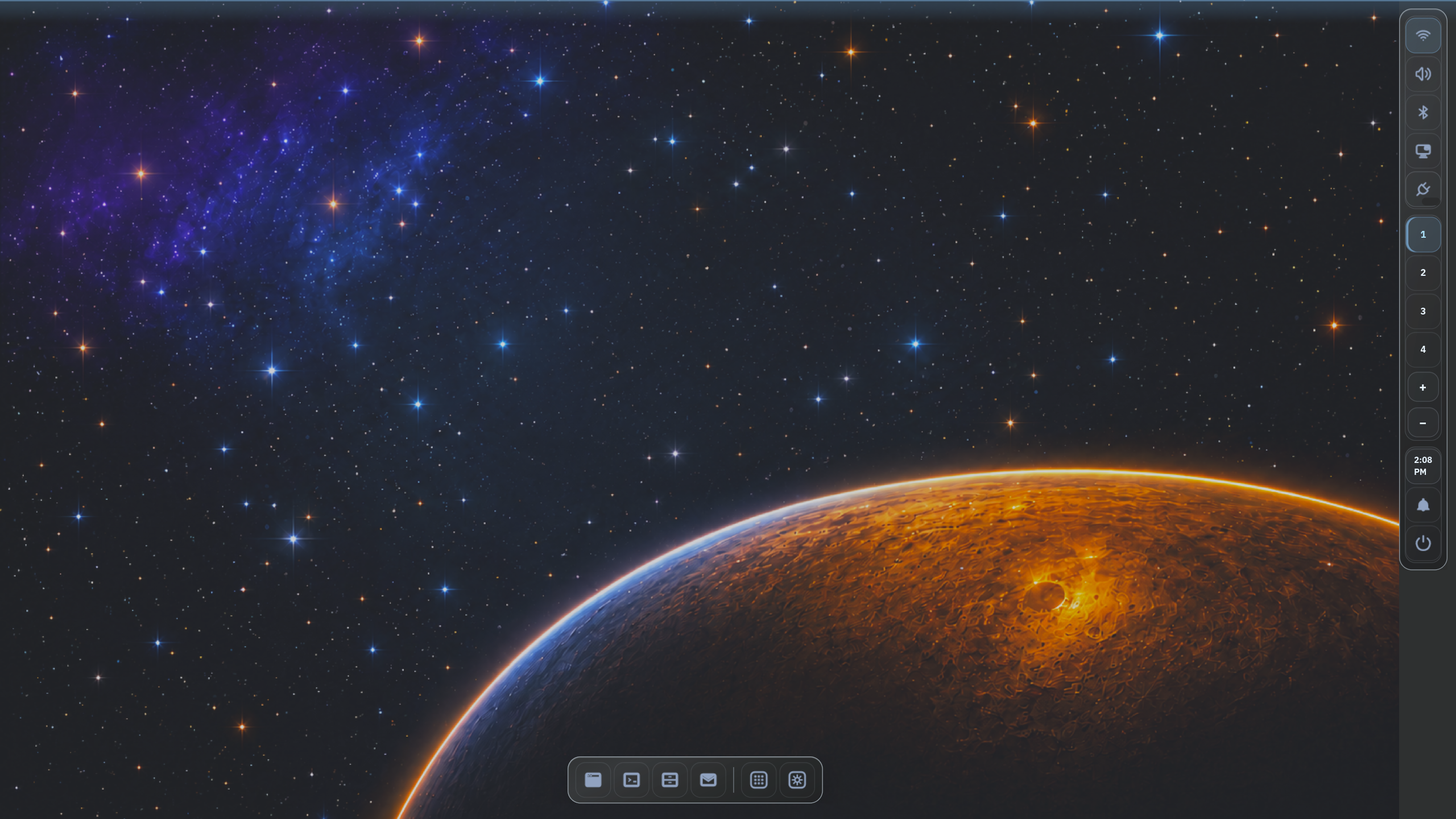
FocalDesk running as a complete desktop session, not just a compositor demonstration.
A compositor sits at the center of a Wayland session. It receives input, decides where surfaces belong, coordinates frames, and presents pixels to displays. That centrality creates a dangerous temptation: when the desktop needs one more capability, the compositor is the easiest place to put it.
Application launching? Add it to the compositor. Notifications? The compositor already draws the shell. Power controls, settings, screen capture, dialogs, model requests? They all need to interact with the session, so pulling them inward can feel efficient.
It is efficient—until one slow operation becomes a dropped frame, one blocked request freezes input, or one recoverable service bug takes down the entire desktop. FocalDesk began as an experiment in building a Rust compositor with Smithay. It became a deeper exercise in deciding which responsibilities deserve to share a failure domain.
The compositor is critical. It is not the whole desktop.
The frame loop has a simple but unforgiving job: remain responsive. Its responsibilities include surfaces, focus, workspaces, input routing, output state, shell geometry, rendering, and frame coordination. These concerns share tight timing and state relationships, so keeping them together is useful.
Most desktop features have a different operational shape. Launching an application may touch the filesystem and parse desktop entries. A power action crosses a privileged system boundary. A notification can arrive while its client is disappearing. An AI request can take seconds and may need explicit approval before it does anything at all.
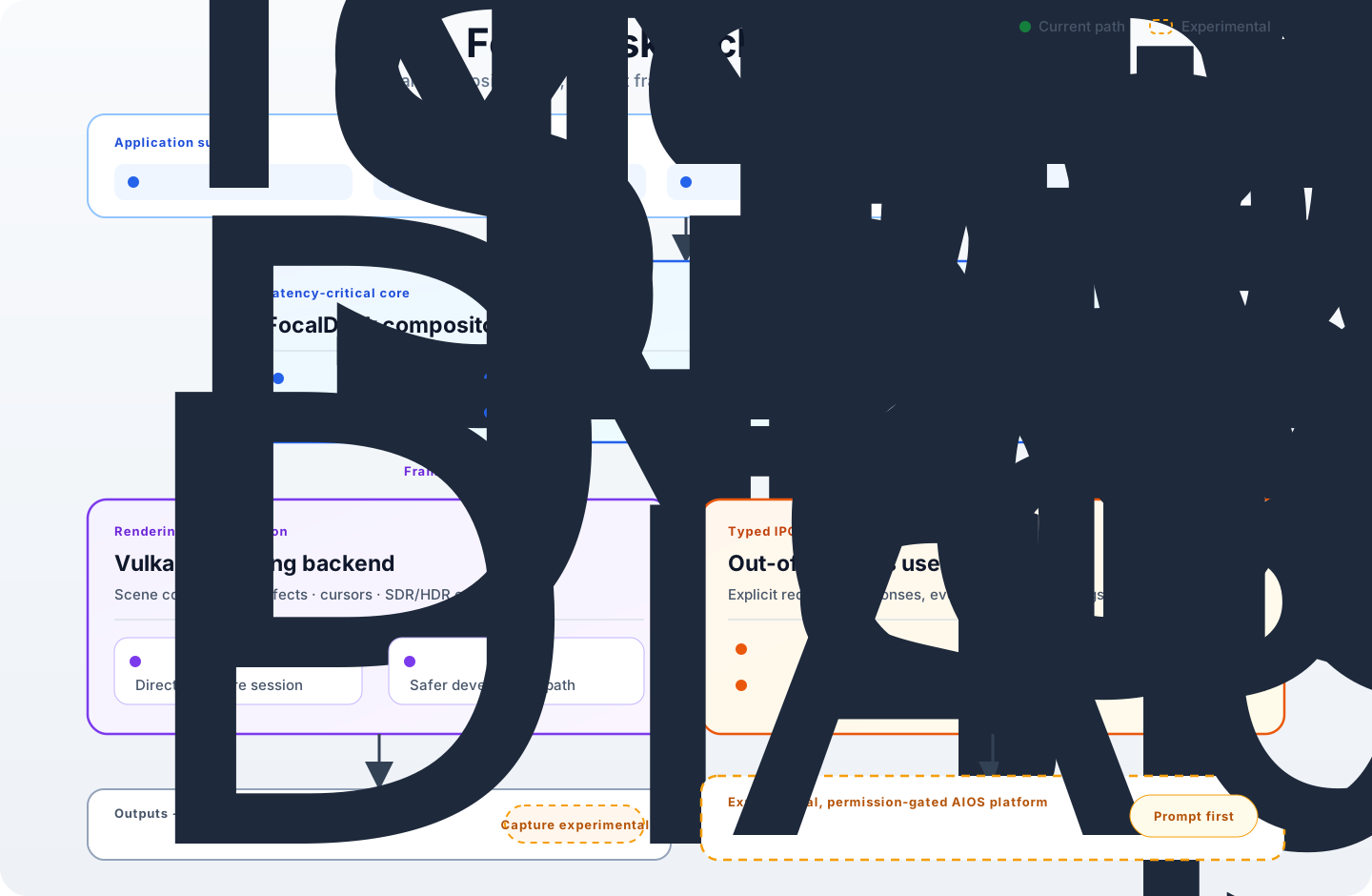
Those operations do not become predictable merely because they are called from predictable code. The architecture has to acknowledge their latency and failure modes. In FocalDesk, supporting capabilities run as separate user services and communicate through typed IPC. The compositor remains the authority for session state, but it does not have to perform every piece of work itself.
The boundary follows timing and failure behavior, not an arbitrary split between “core” and “features.”
A process boundary is only as good as its contract.
Splitting a system into processes does not automatically make it robust. It exchanges local complexity for distributed-systems complexity: message versioning, timeouts, partial failure, startup order, stale state, service discovery, and observability all become explicit engineering work.
That trade is worthwhile when the boundary reflects a real difference in ownership or failure behavior. FocalDesk uses request, response, and event contracts so callers can distinguish “accepted,” “completed,” “denied,” and “unavailable” instead of assuming that sending a message means the job is done. Services can restart independently; callers must be prepared for them not to exist yet—or to disappear mid-operation.
01
State has an owner
Each fact has one authoritative home. Other processes receive snapshots or events, not shared mutable state.
02
Failure is a response
Unavailable and denied are normal outcomes that the interface must represent, log, and recover from.
03
Latency is visible
A request that can take time is modeled as asynchronous work, never disguised as a quick local call.
Permissions belong in the interaction, not in a policy file.
AI integration made the architecture’s consequences especially clear. Generating text is one category of operation. Opening an application, reading a file, changing a setting, or controlling the session is another. A desktop should not collapse those categories into one blanket grant.
FocalDesk routes action requests through a native permission path. The request stops, the desktop shows what is being requested, and a person can approve or deny it before execution continues. The permission decision is part of the protocol, not a decorative prompt layered over an action that has already begun.
A model request pauses at a desktop-owned permission boundary.
Technology choices follow the boundary.
Rust, Smithay, and OpenGL ES are important parts of FocalDesk, but none of them is the architecture by itself. I chose Smithay because it provides Rust-native Wayland building blocks without prescribing the desktop around them. Rust’s ownership and concurrency rules help enforce invariants in session-critical code. OpenGL ES supplies the rendering capabilities this compositor needs without taking on Vulkan’s explicit resource and synchronization surface.
Each choice is intentionally bounded. Rust can prevent broad classes of memory errors, but it cannot decide who owns a piece of distributed state. IPC can isolate a crash, but it cannot invent a recovery strategy. A fast renderer cannot compensate for blocking work in the input path. The design still has to make the system’s promises clear.
What the boundary buys—and what it costs.
The immediate benefit is a smaller critical core. Supporting services can evolve, restart, and fail without automatically ending the graphical session. The same seams also make the desktop easier to inspect: service health, messages, permissions, and state transitions are things the system can expose instead of hiding them inside one process.
The cost is rigor. There are more lifecycle states to test, more contracts to document, and more degraded modes to design. Startup and shutdown need orchestration. Logs need enough context to connect events across process boundaries. Compatibility changes must be deliberate.
For FocalDesk, that is the right complexity to own. A desktop session is a long-running system that mediates between hardware, applications, services, and a person. Pretending those pieces fail together cleanly would make the implementation simpler only on paper.
The goal is not the fewest processes. It is the smallest failure domain that still preserves coherent ownership.
A working rule for systems beyond the desktop.
The frame loop is specific to a compositor, but the design question is general: what part of your system carries the promise users notice first? It may be an event loop, an API request path, a control plane, or a storage transaction. Protect that path from work with unrelated latency and failure behavior. Give the displaced work a real contract, a clear owner, and an honest degraded mode.
FocalDesk is still alpha software. Some services and first-party applications are prototypes, and several APIs are evolving. But the system is far enough along to validate the architectural bet: a desktop can feel like one cohesive product without being one indivisible process.